
I want to propose to my girlfriend on a canal boat in Amsterdam what are my options
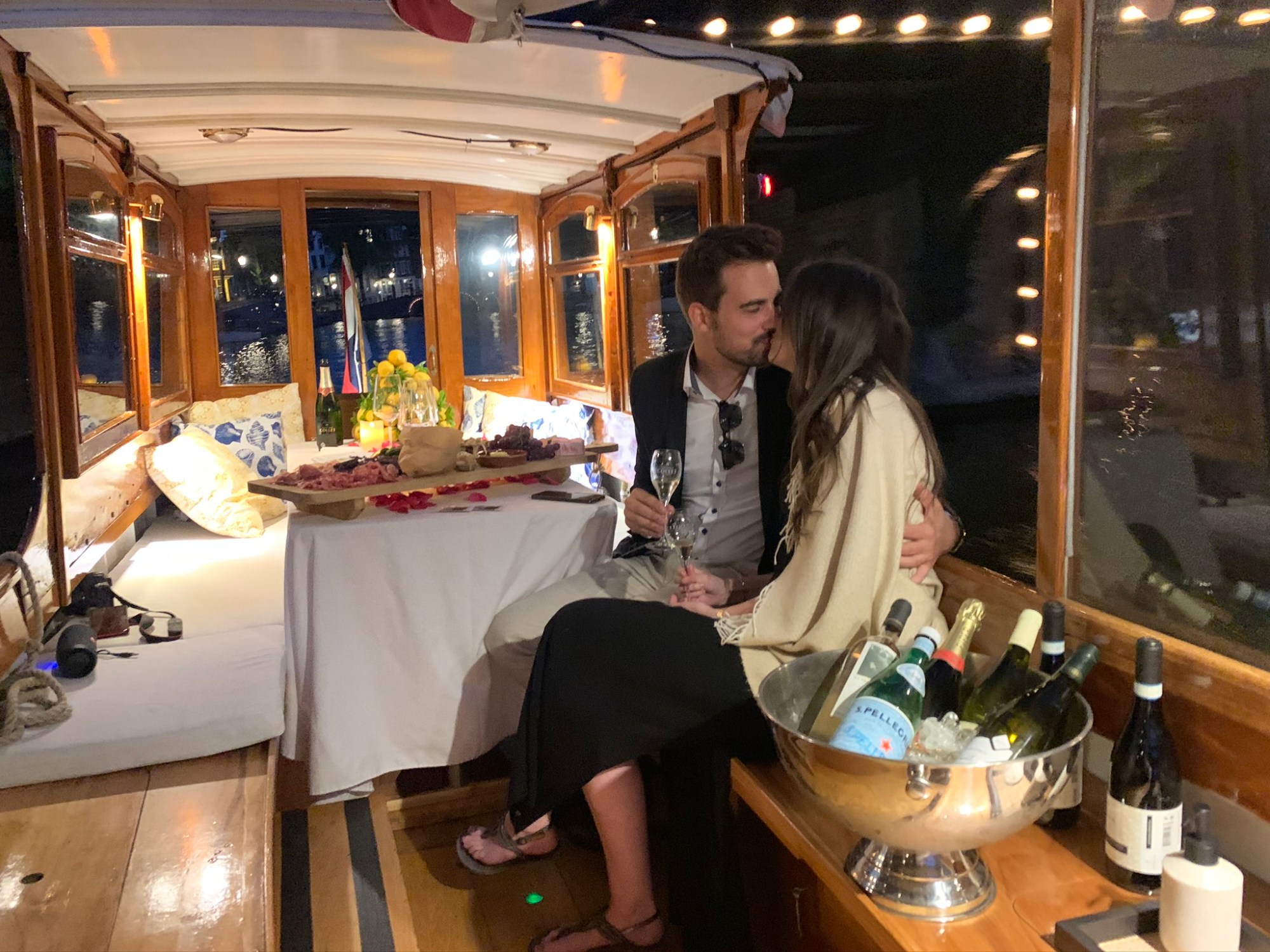
There is a moment on the Amsterdam canals — roughly forty minutes before the sun goes down — when the water turns the colour of brass, the gabled facades catch fire, and the city goes quiet enough that you can hear the bow cutting the surface. It lasts about twenty-five minutes. If you are going to ask someone to marry you, that is the window.
This guide covers the three things that actually decide whether a proposal cruise works: which boat you are standing on, which route you take, and what time you leave the dock. The last one is the one most people get wrong, so we have calculated it for you for the entire year.
Choosing your boat: Delphine or Leaudine
Both are fully electric, so there is no engine noise and no diesel smell — just the sound of water and the occasional bicycle bell from the quay. Both are heated with blankets in winter and both depart from the wooden dock in front of the H’ART Museum at Amstel 51, a few minutes from Waterlooplein.
The short version: if it is only the two of you and you want the most intimate, most historic hull on the water, take Delphine — she was built to fit through the tightest bridges in the city, which is exactly what the Jordaan route demands. If you are proposing and then celebrating over a three-course dinner picked up from a restaurant on the Prinsengracht, take Leaudine.
Route 1 — The Skinny Bridge Loop
Duration: 1.5 hours · Propose at: minute 55 · Best boat: either
This is the classic, and it is the classic for a reason. You leave the H’ART dock and turn straight onto the Amstel, the widest, calmest stretch of water in the centre — which means an open sky, an unobstructed sunset, and no other boats crowding your moment.
The route: H’ART Museum dock → south on the Amstel past Theater Carré → turn at the Amstelsluizen → back north under the Magere Brug → past the Blauwbrug → into the Herengracht → return via the Amstel.
Why the Magere Brug: the first bridge here went up in 1691 as the Kerkstraatbrug with thirteen arches, and it was so narrow that locals nicknamed it the “skinny bridge.” Archive research suggests the real reason it was skinny is that a grand stone bridge had been planned during the Golden Age, but the economic collapse of 1672 forced the council to scale the design back to something basic. The white double-leaf drawbridge you see today was designed by Piet Kramer and built in 1934, and it has been closed to car traffic since 2003 (Wikipedia, Amsterdam for Visitors).
The detail that makes the proposal: the bridge carries 1,200 light bulbs that are switched on in the evening (Wikipedia). Time your cruise so you are approaching from the south just as they come on, and the whole structure ignites over the Amstel with a full mirror reflection in the water. Travel writers consistently rate the hour after sunset as the peak moment here, when there is still enough ambient light to see the river landscape while the bridge illumination takes over (Fodor’s).
There is also a legend worth telling your partner while you approach: two sisters lived on opposite banks of the Amstel and wanted to visit each other daily, so they commissioned a bridge — but could only afford a very thin one (Fodor’s). It is almost certainly not true. It is still a very good story to be telling right before you stop mid-sentence and reach into your pocket.
Route 2 — The Seven Bridges Route
Duration: 1.5–2 hours · Propose at: the Reguliersgracht–Herengracht crossing · Best boat: Delphine
If Route 1 is about open sky, this one is about a single, engineered, once-in-a-lifetime frame.
The route: H’ART dock → Amstel → Herengracht westbound → pause at the Reguliersgracht crossing → south down the Reguliersgracht → Prinsengracht → Amstel and home.
Why it works: the Reguliersgracht was dug in 1664 as a connecting channel during the Golden Age canal expansion. Because it was never meant to be a grand canal, it is narrower and its bridges sit closer together than elsewhere — and the result is that from one precise point, seven arched bridges stack up behind each other in a single visual corridor (The viewpoint sits where the Reguliersgracht meets the Herengracht, just off Thorbeckeplein, inside the UNESCO-listed Grachtengordel (Amsterdam for Visitors).
Depending on your exact angle you can count anywhere from six or seven arches to fifteen, because the sightline picks up bridges over the parallel canals too — the famous “seven bridges” and “fifteen bridges” views are the same spot described by two people who counted differently (alle.travel).
The advantage of doing it by boat: from the quayside, the arches do not quite line up unless you are unusually tall — you would practically need to be on stilts (DutchAmsterdam). Sitting low on the water in a salon boat puts your eye almost exactly at the height where the alignment snaps into place. Ask your skipper to hold position at the crossing. Photographers agree the golden hour before sunset gives the most flattering light here, and after dark the bridges are lit, so a slightly later slot gives you seven glowing arches instead of seven stone ones (ThingsToDoInAmsterdam).
Route 3 — The Jordaan Hidden Canals Route
Duration: 2 hours · Propose at: Bloemgracht or Egelantiersgracht · Best boat: Delphine
For couples who would rather not do their most private moment in front of an audience of tourists on a bridge.
The route: H’ART dock → Amstel → Prinsengracht northbound → Brouwersgracht → south into Bloemgracht → Egelantiersgracht → Leliegracht → back via the Keizersgracht.
Why it works: west of the Prinsengracht, the Jordaan is threaded by a grid of small side canals — Bloemgracht, Egelantiersgracht, Lauriergracht, Looiersgracht — that most cruise operators skip entirely . The Brouwersgracht, the Brewers’ Canal, runs along the northern edge and takes its name from the seventeenth-century breweries that lined it; those warehouses are now among the most sought-after addresses in the city . The Egelantiersgracht is quieter still, lined with houseboats and ending near the Claes Claesz Anslo almshouse .
Practical note: these canals are narrow and the bridges are low. This is precisely the route that requires a small hull — Delphine is documented as being able to sail through the smallest canals of Amsterdam where other boats cannot follow Confirm the Jordaan leg with your skipper when you book; route flexibility through the Jordaan, the old centre and beyond is standard on private tours (Private Boat Tour Amsterdam FAQ).
The timing: sunset in Amsterdam, month by month
This is the part that decides everything. A 1.5-hour cruise that boards at the wrong hour puts your proposal in flat grey daylight or in full dark.
The rule: board 45 minutes before sunset. That places your first landmark in golden hour, your proposal within a few minutes of sunset itself, and your return leg in blue hour with the bridge lights coming on.
The table below is calculated for Amsterdam (52.37° N, 4.90° E) in local time, including daylight saving. Golden hour is the start of the warm low-light window; blue hour end is when true darkness sets in.
Latest sunset of the year: 22 June 2027 at 22:06.
Earliest sunset of the year: 9 December 2026 at 16:26.
Note the jump between 15 March and 1 April — that is daylight saving time, which moves clocks forward on the last Sunday of March. Sunset leaps by about an hour and a half overnight.